05 — Use Cases
Part of the Domain Connect Knowledge Base
Overview
Domain Connect was designed for a specific problem: the gap between "domain registered" and "domain in active use." Its primary use case is service integration — connecting a user's domain to a third-party service. But the protocol's architecture creates opportunities well beyond that original use case.
Primary Use Case: Service Integration
Website Builders and E-Commerce
Scenario: A user has registered a domain and now wants to use it with a website builder or online store.
Without Domain Connect: The user receives instructions listing 5–15 DNS records to create manually across two different systems. Approximately half fail to complete this process.
With Domain Connect: The user types their domain into the service's interface. The service detects that the DNS provider supports Domain Connect. The user clicks "Connect," logs into their DNS provider, sees a plain-language description of what will be configured, approves, and is done.
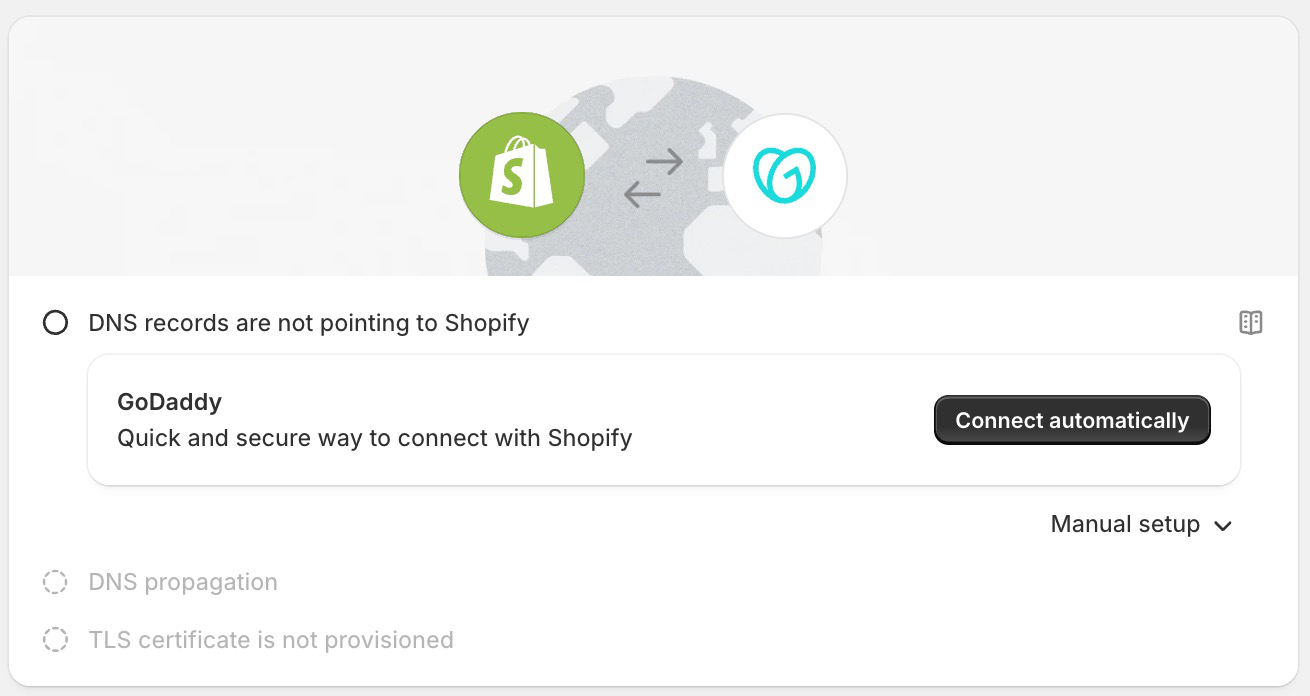
Real-world example: Shopify detects GoDaddy Domain Connect support and surfaces a one-click setup button. "Manual setup" remains available as fallback.
Real-world examples: Shopify, Squarespace, Weebly, and other website builders have deployed Domain Connect templates with major DNS providers.
DNS records typically involved: A or CNAME (to point the domain to the hosting platform), TXT (for ownership verification)
Email Services
Scenario: A business wants to use a professional email service (e.g., Microsoft 365 or Google Workspace) with their custom domain.
Without Domain Connect: Microsoft 365 requires users to create 7–15 records across multiple types: MX (for mail routing), multiple TXT records (for SPF and domain ownership), CNAME records (for autodiscover and other services). Microsoft maintains 16 help articles, 10 of them registrar-specific, because each registrar's interface is different.
With Domain Connect: One click. The DNS provider applies all the required records in a single operation, using a pre-vetted template that includes proper SPF merging to avoid conflicts with existing email configuration.
DNS records typically involved: MX, TXT (SPF, DKIM, domain verification), CNAME (autodiscover, mail clients)
Authentication and Security Services
Scenario: A service needs to establish trust for DKIM signing, set up BIMI (Brand Indicators for Message Identification), or configure STS policies.
With Domain Connect: Complex TXT records with precise syntax requirements can be applied reliably, without transcription errors that break DKIM validation.
DNS records typically involved: TXT (DKIM public keys, SPF entries, BIMI indicators), CNAME (for external key rotation services)
CDN and Performance Services
Scenario: A user wants to route their traffic through a CDN or DDoS protection layer.
With Domain Connect: CNAME records for subdomains (e.g., www) can be configured with one click. The service defines the target CNAME in its template; the user approves.
DNS records typically involved: CNAME, A/AAAA, TXT (ownership verification)
VoIP and Communication Services
Scenario: A business wants to configure SIP/VoIP service on their domain.
With Domain Connect: SRV records (which require correctly formatted priority, weight, and port fields) can be applied reliably through a pre-defined template.
DNS records typically involved: SRV, TXT
Multi-Step Flows: Verification Then Configuration
Many services require a two-phase DNS configuration:
- Phase 1: Prove domain ownership (TXT record)
- Phase 2: Configure the actual service (MX, CNAME records)
Domain Connect's template groups (groupId) and the asynchronous OAuth flow (async extension draft) are designed exactly for this pattern:
User approves once (OAuth flow)
  → Service Provider applies verification records (groupId=verification)
  → SP polls for verification success
  → SP applies service records (groupId=service)
  → User notified of completion
The user sees one consent screen; all subsequent steps happen automatically in the background.
Extended Use Cases
These are valid Domain Connect applications that go beyond the original service-integration scenario, particularly relevant for registries and registrars.
DNSSEC Bootstrapping
Current state: The standard DNSSEC bootstrapping mechanism (using CDS and CDNSKEY records, per RFC 8078) requires the registry to periodically poll DNS zones looking for records that signal a domain owner wants DNSSEC enabled. This creates delays and is inefficient at scale.
Domain Connect application: A DNS provider that has enabled DNSSEC for a zone could use a Domain Connect-like flow to signal DNSSEC readiness to the registry and provide DS records in real time. Instead of the registry polling, the DNS provider initiates an explicit, event-driven handshake.
Benefit: Real-time DNSSEC delegation without polling latency. Particularly valuable for TLDs with millions of zones.
Automated Nameserver Changes
Current state: Moving a domain to a new DNS provider requires the user to navigate their registrar's control panel, manually enter new nameserver hostnames, and wait for registry propagation.
Domain Connect application: A DNS provider offering a nameserver migration service could define a template that, when applied, configures the new nameserver delegation. The registrar (acting as the DNS Provider in the Domain Connect flow) updates the NS delegation at the registry level — all in a single user-approved action.
Benefit: One-click nameserver migration with built-in verification.
Sell-and-Configure Flow
Current state: Service providers that want users to use custom domains face a two-step problem: the user must first register a domain (somewhere), then configure it (somewhere else). These are separate flows with high drop-off between them.
Domain Connect application: A service provider (e.g., Shopify) partners with a registrar. When a user wants a custom domain on their store, the registrar registers the domain and Domain Connect immediately configures it — all without the user leaving the service provider's interface.
Flow:
User in Service Provider → selects domain → registrar registers it
  → Domain Connect applies DNS configuration
  → User sees their store live on their new domain
Benefit: Collapses a multi-day, multi-platform process into a single session. High potential for domain registration conversion.
Out-of-Scope Use Cases
Understanding what Domain Connect is not designed for is as important as knowing what it does.
CI/CD Pipelines and Automated DNS Management
Domain Connect requires a user to be present (for authentication and consent). It is not designed for headless, machine-to-machine DNS automation. For automated DNS management in DevOps contexts, use DNS provider APIs directly (e.g., Route 53, Cloudflare API, RFC 2136 dynamic DNS).
Private and Enterprise DNS
Domain Connect requires publicly accessible API endpoints. Internal corporate DNS infrastructure, split-horizon DNS zones, and private DNS resolvers are not compatible with this assumption without significant additional engineering.
Arbitrary DNS Zone Management
Domain Connect is not a general-purpose DNS management API. Every change is strictly constrained to what a pre-approved template allows. It cannot make arbitrary DNS edits, delete zones, or manage records outside the template scope.
Domain Registration
Domain Connect configures DNS records for existing registered domains. It does not register domains. The sell-and-configure extended use case requires a separate domain registration step through normal registrar channels — Domain Connect handles only the post-registration DNS configuration.
Use Case Summary
| Use Case | Flow | Status |
|---|---|---|
| Website builder / e-commerce | Synchronous | Core; widely deployed |
| Email service setup (M365, Google Workspace) | Synchronous | Core; widely deployed |
| Authentication / DKIM / SPF setup | Synchronous | Core |
| CDN / performance service | Synchronous | Core |
| VoIP / SRV-based services | Synchronous | Core |
| Multi-step (verify then configure) | Asynchronous | Core; requires OAuth implementation |
| Dynamic DNS (IP address changes) | Asynchronous | Core; requires OAuth implementation |
| DNSSEC bootstrapping | Extended | Proposed; not yet standardized |
| Nameserver migration | Extended | Proposed; requires registrar integration |
| Sell-and-configure | Extended | Proposed; requires registrar partnership |
| CI/CD automation | — | Out of scope |
| Private/enterprise DNS | — | Out of scope |
| Arbitrary zone management | — | Out of scope |
Previous: 04 — Protocol Features | Next: 06 — Value by Audience